1
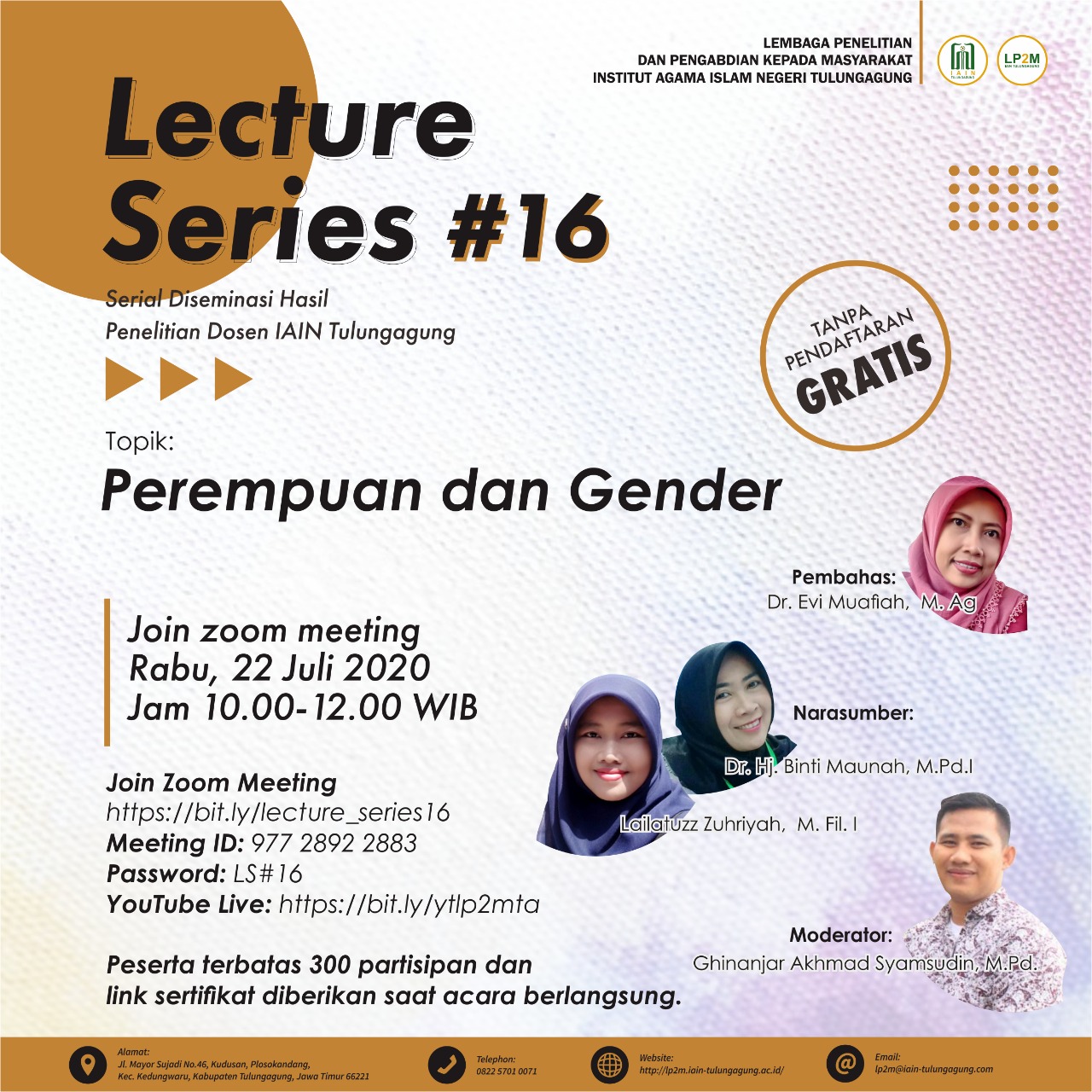
TULUNGAGUNG – Research and community service institute (LP2M) IAIN Tulungagung held a lecture series to 16, Wednesday (22/7/2020) via the zoom application.
In this discussion, The speakers explained the research results. Two lecturers who were speakers, namely Dr. Hj. Binti Maunah, M.Pd.I and Lailatuzz Zuhriyah, M.Fil.I. Besides that, there was a discussant regarding the presentation of two sources, namely Dr. House Exempt, M. Ag. from IAIN Ponorogo.
The two sources explained the results of their research carried out on 2019. Binti Maunah presents research on the dynamics of women in structural departments at the State Islamic Religious College (PTKIN). Multi Site Study at UIN Maulana Malik Ibrahim Malang, IAIN Tulungagung, and IAIN Kediri. Whereas, Lailatuzz explained the shifting patterns of gender relations and their impact on the families of Indonesian Migrant Workers (PMI)
in Tulungagung Regency.
In his presentation Uun, Her nickname explains that the dynamics of women in structural positions are different across the three campuses. He revealed an analysis of the dynamics of women on the three campuses.
At UIN Malang, he said there were no restrictions between men and women in occupying structural positions. Then, There are still strong views that women are more suited to household work than men. As well as, There is a religious interpretation that women are in a subordinate position to men or are under male leadership.
At IAIN Tulungagung, There is no difference between male ASN and female ASN, every female ASN is entitled to a structural position. Then, determining and assigning structural positions to female ASNs based on existing competencies and achievements because not all ASNs get them.
Whereas, at IAIN Kediri, it was stated that there were restrictions on women's movement which meant that women had very little access to the economy, access to information is also very small. As well as, Women have very little power compared to men and there are still strong views that women are more suited to household work than men..
This woman, who is also the Dean of the Faculty of Tarbiyah and Teacher Training, also gave conclusions on the findings from her research, namely the dynamics of women in structural positions in the form of no difference between male ASN and female lecturers.. Every female ASN has the right to obtain a structural position based on their competencies and achievements.
Second, The factors causing the emergence of dynamics of women in structural positions are educational factors, culture, expertise, ability, performance, rank/department, internal, or external.
Then, forms of female dynamics in the structural department, among others cooperation, assimilative, amalgamation, accommodation, and mutual cooperation.
Whereas, The strategy used by women to gain trust in structural positions is to improve the quality of education, quality of competence and resources, have awareness of abilities, have the ability to change with strong determination, as well as promoting equality, and gender justice.
Meanwhile, Lailatuzz said his research took objects in Tulungagung, specifically taking samples in one sub-district, namely Rejotangan—the easternmost region in Tulungagung which directly borders Blitar Regency—with the consideration that the subdistrict begins 2017 until now it still occupies the top position for sending the most PMI abroad. The hope, This research could be a follow-up plan for the community assistance program.
The results of this research, he said, The background to the shift in gender relations patterns among PMI in Rejotangan District, Tulungagung, is as follows.
From the two villages that the researchers used as samples, All interviewees said that the background to the shift in gender relations was due to factors economy and the difficulty of men finding work.
This was followed by the emergence of new policies that increasingly tightened the rules for men and cost a lot of money. For, To get around this, it is the wife who goes abroad to replace the husband's role as the backbone of the family.
From the speech of the chairman of KKBM, researchers came to the conclusion that economic factors are not the only background but also the cause mindset what is embedded is the worker's mentality.
This happens not because they are born with it but because of the colonial legacy and socio-cultural constructs that occur around them. If you borrow the glasses of Marxism, they actually experience false consciousness as a result of the unequal system between the capital owners and the proletariat. Because it is not consciousness that determines human existence, on the contrary, it is social circumstances that determine their consciousness.
Then, Factors of shifting gender relations in influencing sex(No)Family harmony is not completely true. Because not all PMI families who experience shifts in gender relations also experience disharmony or even damage to their households.
There are also those who, from the moment they left until they returned home, were still fine and even happier.
However, from the results of observations in the field and informants' accounts, there are indeed some who experience disharmony due to a loss of trust and a lack of mutual understanding..
On one side, Problems arise from the husband at home who seeks pleasure through various negative activities. On the other hand, there are also problems that arise from women abroad because it starts from being just for fun and ends up being too lazy.
This happened because of cultural influences and free association there. From the source's account, On average, those who fall into this are those who work outside the home, for example in factories or restaurants. Meanwhile, those who work as domestic servants are rare.
This is in line with Arnold Toynbee's thoughts that in the family context, all functions and roles are always required to be in accordance with local patriarchal gender relations patterns., Shifting patterns of gender relations give rise to the potential for disharmony in the family between husband and wife.
This woman, who is also the secretary of the PAI IAIN Tulungagung Masters Study Program, continued, although not all, However, the shift in gender relations in PMI families also has a social-psychological impact on PMI children.
The impacts are varied, some even dropped out of school, didn't go to class until he felt indifferent to his mother when he returned abroad. This happened because of a lack of attention from his father and grandparents and then he was too pampered with facilities.
From the two villages that the researchers used as samples, Although it is relatively small, there are some whose children have dropped out of school and experienced psychological shock which they express through their indifference to education, even their mothers..
This happened as a form of their protest because of the loss of a mother's presence and loving touch. For them, The mother's conception cannot be replaced by that of her father or grandparents.
In contemporary terms, PMI children experience what is called Children Left Behind or the conditions that children have to face related to gaps in material welfare, education, and health when they were left behind by their parents migrating abroad.
This is in line with Tyas Retno Wulan's opinion, et al for their research on CLBs in Banyumas Regency which stated that the feelings of the children of migrant workers generally felt sad and that their mothers were not willing to go abroad..
Besides that, The parenting style applied by parents will have an influence on their children's behavior. Based on the description of the social-psychological impact due to shifting gender relations on PMI children, on average they experience non-compliance.
This happened not only because of social factors but also because of the father's lack of attention. A father's care will influence a child's development and well-being, including when children enter the transition period to adolescence.
Fathers who care for and protect their children well will have a positive impact on the child's growth and development, thereby impacting the father's psychological well-being as well.
However, fulfilling physical needs alone is not enough because it must also be accompanied by good parenting and communication patterns. The facts that have been presented show that the basic needs of being a child, especially those related to psychological needs, especially during adolescence, not fully fulfilled. Even though it can grow and develop optimally, Fulfilling children's needs is not just enough to fulfill physical needs. (*)

 By
By