1
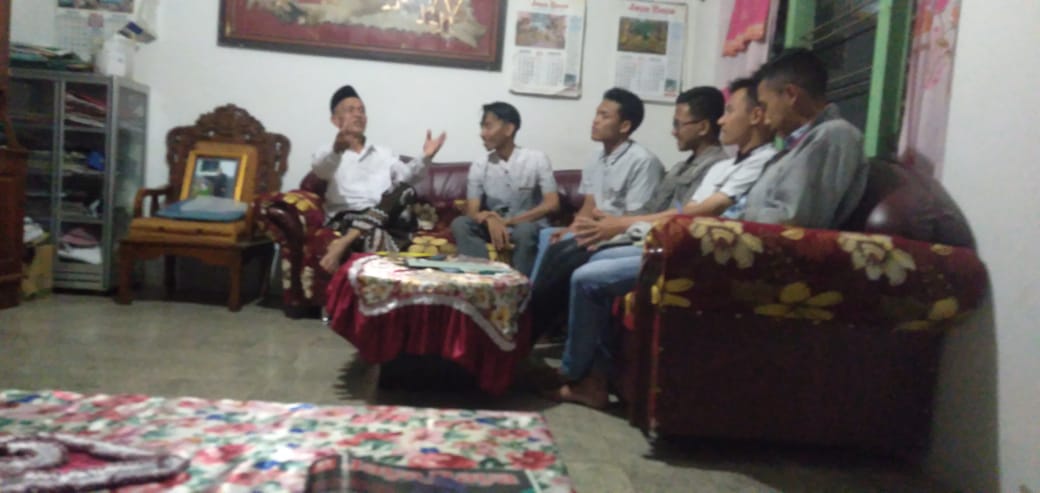
After the Maghrib prayer, we went to the house of the head of Karang Werda. It just so happens that his house is in our region, precisely in the middle part of RT 18. Adjacent to State Middle School 1 Order. If you go from junior high school, you still go south about a hundred meters to the house in the corner in front of the mosque.
The clock strikes 18:30, exactly where the friends from Suruh post are 1 come to the Command post 2. There are lots of them 9 people. Very enthusiastic and I appreciate their curiosity about the story of the beginning of Suruh village. Fifteen minutes after the meeting time, we went to Mr Suparni's residence.
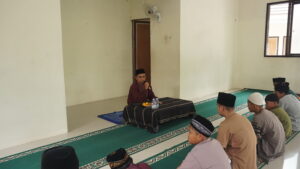
When we got there, we performed the Isha' prayer in congregation at the mosque and Mr. Suparni was the imam. After the evening prayer in congregation, we were invited to enter his house. Our Village Coordinator started the conversation with the intention of making friends, which was then followed by gathering information about the Suruh Village tripe.
Mr Suparni retired about ten years ago. When we met him, he was already seven years old. However, He still frequently attends various events and is active in many organizations. As we know, Apart from being the chairman of Karang Werda, he is also the chairman of the Karawitan association, whose participants are almost all elderly.
In his house there are also many calendars from Jaya Baya magazine. His organizational spirit and literacy are extraordinary. There have been many writings on Javanese poetry, news of events such as during Grebeg Selo (an event to remember the village's ancestors in the month of Selo by cleaning the village, procession from junior high school to the village office, Usually also attended by the Regent of Trenggalek), even eighties textbooks, Wulang Reh, which contains various ways of writing Javanese poetry, still exists and is cared for by him. If you can say that the book is older than the age of us KKN students who come to their house.
According to Pak Suparni, there are two versions of the origins of Suruh Village. The first is that a long time ago, many Suruh trees grew in this village. So called Desa Suruh. If you don't know the Suruh tree, please look for this information in books or the internet to broaden the reader's insight.
Second version, closely related to the Pacitan chronicle, where Raden Ngabei Prawiranata, a Patih of Punakarya Ngawi, started to carve out its history. This started with the outbreak of war between Majapahit and Demak in the Javanese year of the three holy minds of the Brahmins. Brahmin means eight, three is still three, Suci means four and budi is one. The numbers are read backwards, so in year 1438 Majapahit lost to Demak.
Ki Ageng Cakrajaya or commonly known as Ki Geseng, a cleric from Demak came to Ponorogo and started opening Wana (forest). Before opening the wana there, he stuck a Petung bamboo and then the longer the bamboo did triwikrama (change appearance) became a Barongan Deling. So Ki Ageng Cakrajaya is also nicknamed Ki Ageng Petung and according to various stories, Ki Ageng is the son of a student of Sunan Kalijaga..
Ki Geseng opened a wana called Ngrejoso Hamlet and not long after that came Bathara Kathong with his comrade in arms named Maghribi Maulana who also opened a wana not far from Ngrejoso hamlet.. More or less 5 pal (7,5 km) from Ponorogo.
Next came two people from Demak named Ampak Baya and Minak Sopal. In this case, the highlight is Minak Sopal who became duke of Trenggalek. Many Majapahit soldiers ran to save themselves. One of them was Panoyo and several other friends who ran towards the wana which was on the edge of the ocean to the north.
Panoyo is known as a powerful and powerful person. Because of his magic, he was nicknamed Mbah Budho who lived in Nggedong (Gegeduking Poro Sakti). Mbah Budho is often asked for help (ordered) local residents to eradicate the evil spirits in their own area and in other hamlets. Because he was often asked for help, Mbah Budho was better known as a messenger.
The presence of Mbah Budho in the area is a sign that the land that the people walk on or inhabit is called Suruh Village. Mbah Budho has died and is buried in Nggedong, which is in Krajan Hamlet, Suruh Village.
Mr Suparni's story is still ambiguous. There's a lot of information we don't know yet. After telling a brief history of Suruh Village, the discussion turned to many things. Like Javanese songs, the variety of languages that Pak Suparni often used in writing poetry and stories while he was still studying at elementary school to STKIP Trengalek college.
After returning from his house, friends are still discussing the results at the command post. About the time span between the Majapahit and Demak wars and the stopping places which are still a mystery to us. Besides that, he will be very open to all KKN friends who want to dig up information from him or just stay in touch. He also provided information on several people who could be sources for our research. There are four people spread across various corners of Suruh Village. And God willing, we will visit all of them one by one to broaden our insight.
Talking about history, I remember Muhammad Yamin. In his words he stated that the ideals of Indonesian unity were not empty talk, but truly supported by forces that arise at the roots of our nation's history. Hopefully this millennial generation and future generations will always pay attention to the history of their own nation, until finally not oppressed by foreigners in their own country.

 By
By