


1
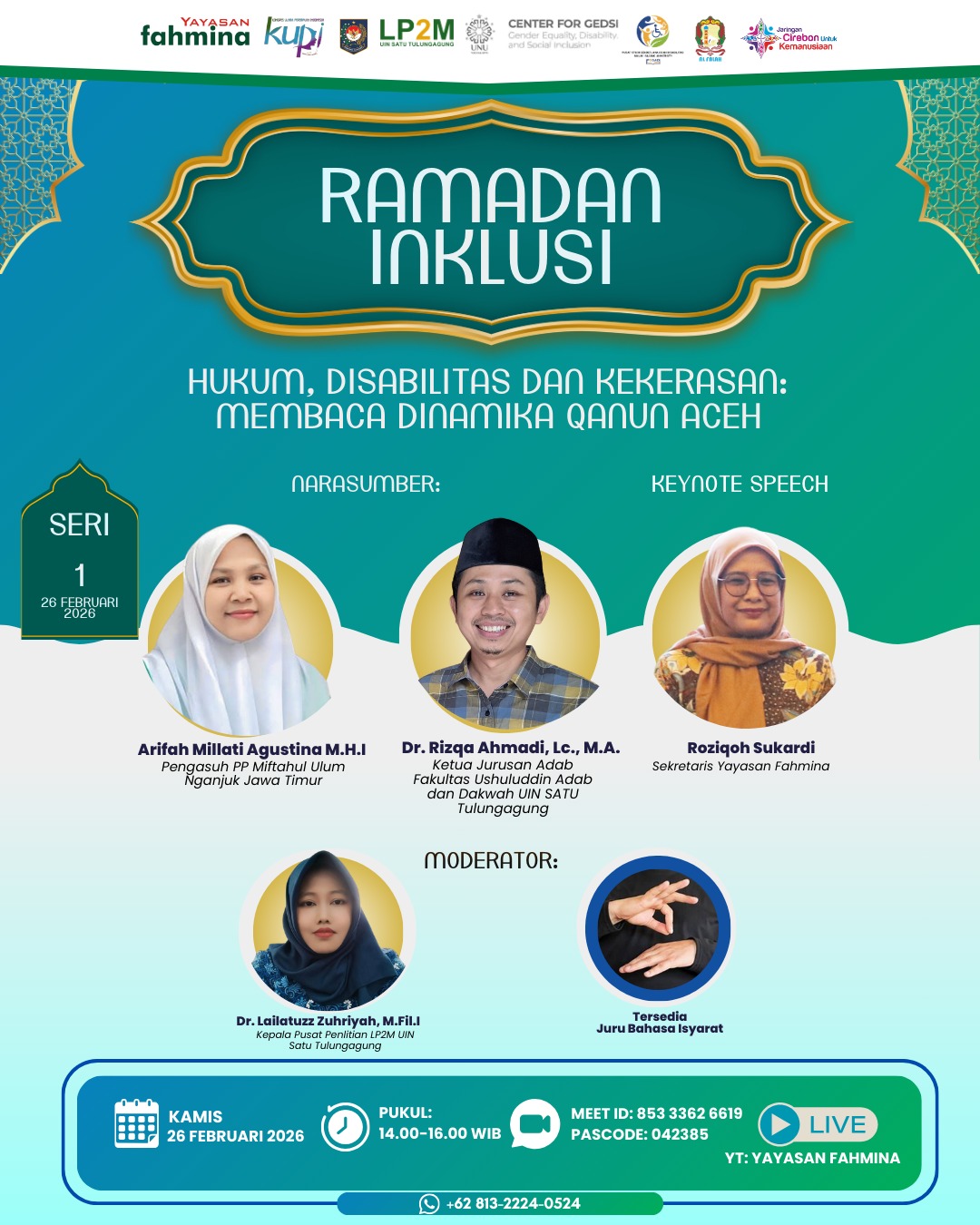
Tulungagung, 26 February 2026 – Efforts to provide inclusive justice for people with disabilities are the main focus in Inclusive Ramadan Koran activities “Study of Ramadan Inclusion of Women Ulama to Advocacy for Disabled Rights” which was organized by the Fahmina Foundation in collaboration with LP2M UIN Sayyid Ali Rahmatullah Tulungagung, Center for GEDSI UNU Yogyakarta, PSGAD UIN Malang, and Al Falah Islamic Boarding School, Salatiga, on Thursday (26/2/2026).
This activity, which was carried out online via Zoom and broadcast live via the Fahmina Foundation's YouTube channel, was attended by various important elements, including the Chair of the Fahmina Foundation, Marzuki Rais; Secretary of the Fahmina Foundation, Roziqoh Sukardi and team; Mubjadi Director Zahra Amin and Mubjadi contributors; Caretaker of the Al Falah Islamic Boarding School in Salatiga, Nyai Siti Rofiah, M.A.; Head of PSGAD UIN Malang and team; Center for GEDSI UNU Yogyakarta Team; activists and disability studies activists, academy, as well as Islamic boarding school communities from various regions.
The event was opened by Roziqoh Sukardi, Secretary of the Fahmina Foundation, who in his speech emphasized the importance of building collective awareness that advocacy for the rights of persons with disabilities is an integral part of the value of Islamic justice. He emphasized that Ramadan is a spiritual and social momentum to reflect on the role of religion in defending vulnerable groups and ensuring the presence of a more inclusive and just social system..
After opening, The activity continued with the main session moderated by Dr. Lailatuzz Zuhriyah, M.Fil.I., Head of the LP2M UIN Research Center Sayyid Ali Rahmatullah Tulungagung.
In the introduction, Dr. Lailatuzz Zuhriyah, M.Fil.I. emphasized that Islam as a religion of mercy has a moral responsibility to ensure that every human being, without exception, obtain protection, dignity, and equal access to justice. He also emphasized the importance of dialogue between fiqh as a normative foundation and law as a social instrument, so that both can work together to bring substantive justice to people with disabilities.
First resource person, Dr. Rizqa Ahmadi, Lc., M.A., Head of the Department of Adab, Faculty of Ushuluddin, Adab, and UIN Da'wah Sayyid Ali Rahmatullah Tulungagung, delivered material entitled "Law, Disability and Violence: Reading Dynamics Law Aceh.” In his presentation, he explained that although regulations in Aceh had experienced significant developments since the special autonomy era until the birth of the latest qanun regarding the rights of people with disabilities, There is still a gap between legal norms and implementation in the field.
He highlighted various challenges, such as the disability perspective not being fully integrated in the justice system, limited accessibility for victims of disabilities, as well as structural vulnerabilities that are exacerbated by social stigma and unequal power relations. According to him, Legal reform oriented towards inclusive justice is an urgent need to ensure that the legal system truly protects vulnerable groups.
Meanwhile, second source, Nyai Arifah Millati Agustina, M.H.I., Caretaker of the Miftahul Ulum Nganjuk Islamic Boarding School and lecturer at the Faculty of Sharia and Legal Sciences at UIN Sayyid Ali Rahmatullah Tulungagung, delivered material entitled "Disability Jurisprudence: From Texts to Social Transformation.”
He explained that Islamic jurisprudence has character murūnah (flexibility) which allows Islamic law to respond to the diversity of human conditions, including the experiences of people with disabilities. He emphasized that people with disabilities should no longer be positioned as mere objects of pity, but as a full subject having capacity, experience, and authority in the formation of legal understanding.
According to him, Fiqh must move from paradigm charity-based going to rights-based, from the dispensation paradigm to the empowerment paradigm. In this perspective, Advocating for the rights of people with disabilities is not just a social agenda, but it is part of religious responsibility to realize justice.
The discussions are dynamic, especially from questions and statement said by one of the activity participants, Dr. Zulfatun Ni'mah. This shows the high enthusiasm of the participants. The developing dialogue emphasizes the importance of synergy between Islamic scientific traditions, legal system, and social movements in building an inclusive society.
Dr. Lailatuzz Zuhriyah, M.Fil.I. as moderator closed the activity with a reflection that transformation towards inclusive justice requires joint work across sectors, including scholars, academy, educational institutions, and civil society. He emphasized that religion has great potential as a liberating force, which not only provides normative legitimacy, but also mobilize real social transformation.
This inclusive Ramadan Koran activity is an important part of efforts to strengthen the role of female ulama, academy, and religious institutions in advocating for the rights of people with disabilities, while at the same time affirming our shared commitment to present Islam as a blessing for all humans (rahmatan lil ‘alamin). (El-Zet)

 By
By