



1
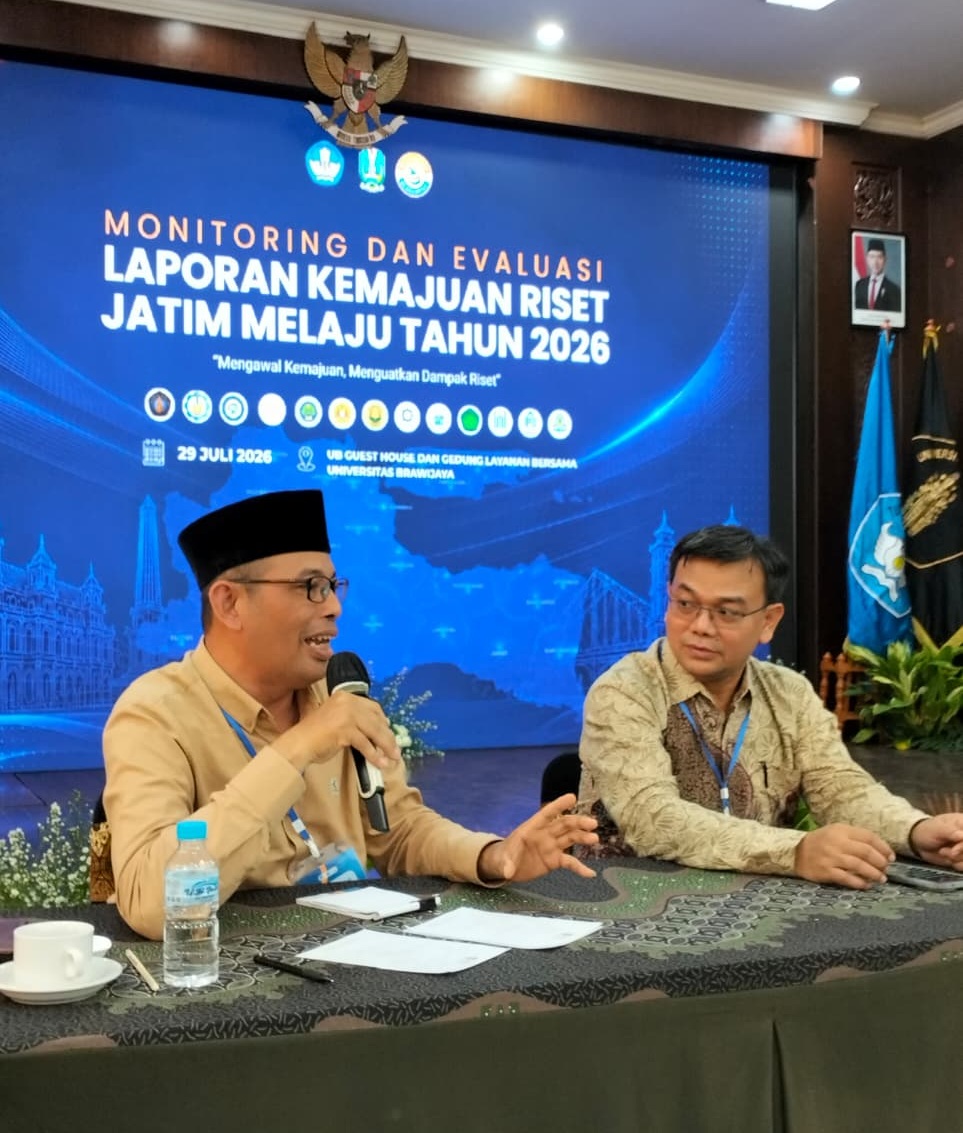
LP2M UIN SATU Tulungagung News Room – Malang, 29 July 2026 – After participating in Monitoring and Evaluation activities (Monev) East Java Research Progress Report Progresses Yearly 2026, Institute for Research and Community Service (LP2M) UIN Sayyid Ali Rahmatullah Tulungagung, which was followed by the Head of LP2M, Prof. Dr. Drink Naim, M.H.I. and Head of the LP2M Research Center, Dr. Lailatuzz Zuhriyah, M.Fil.I. continuing his participation in the LPPM/LP2M/DRPM Forum Coordination Meeting for State Universities (PTN) and Legal Entity State Universities (PTNBH) East Java which was held in the Meeting Room Floor 3 Brawijaya University Guest House, Malang.
This forum is a strategic forum for LPPM/LP2M/DRPM leaders to evaluate the implementation of the East Java Melaju Research Program as well as formulate directions for its development in the coming years..
The coordination meeting was guided by the Director of the Directorate of Research and Community Service (DRPM) Brawijaya University, Prof. Luchman Hakim, who emphasized the importance of overseeing the sustainability of the East Java Research Program so that it does not only produce academic output, but also has a real impact on the development of East Java.
This forum is also a consolidation space for LPPM/LP2M PTN, PTNBH, and PTKIN in strengthening research synergies across universities.
On this occasion, Chairman of LPPM Surabaya State University (UNESA), Prof. M. Turhan Yani, said that the East Java Melaju Research Program in the first year had involved 13 universities in the consortium, with two major theme families, namely STEM and SHARE (Social, Humanities, Arts, Religion, and Education).
According to him, Each university has unique scientific knowledge that needs to be collaborated on to be able to produce more comprehensive and impactful research. He also emphasized the importance of monitoring research outputs so that they really make a real contribution according to the initial goals of the program.
Besides that, UNESA will host the Melaju East Java Research Results Seminar in early December 2026 which will be coupled with a Research Poster Expo for the entire consortium. On this occasion, the determination of the host for the implementation of the Jatim Melaju Tahun Program will also be discussed 2027.
Representing LP2M UIN Sayyid Ali Rahmatullah Tulungagung, Head of LP2M, Prof. Drink Naim, said that the East Java Melaju Research Program was the first experience for PTKIN in East Java in participating in a cross-university collaborative research scheme.
According to him, this program makes an important contribution to the achievement of Key Performance Indicators (THAT) Higher education also provides momentum to strengthen the culture of collaboration between researchers.
Prof. Naim also proposed that various technical and administrative aspects of the East Java Melaju Program continue to be refined. First year, according to him, must be used as a foundation for conducting a comprehensive evaluation so that implementation in the following year will be better.
He also proposed special monitoring in September to map the progress of each research team's output, identify various obstacles, and develop strategies to accelerate the achievement of publication targets and research outputs.
Constructive input also came from the Chair of LP2M UIN Madura, Prof. Erie Hariyanto, which highlights that there are still obstacles in the mechanism for finding research partners. According to him, The consortium formation system needs to be refined so that lecturers have certain expertise, especially in STEM fields, easier to find suitable partners.
Besides that, monitoring of publication achievements also needs to be carried out periodically to ensure that research output targets can be achieved optimally.
Representative of the Directorate of Research and Community Service, State University of Malang (ONE), Prof. Harry, proposed that the East Java Melaju Program in the future should not only focus on research, but also opens a Community Service scheme (PKM) collaboratively so that research results can be implemented more widely in society.
Meanwhile, Prof. Purwo from the Directorate of Research and Innovation, Airlangga University (UNAIR) emphasized that the direction of development of the East Java Melaju Program needs to be focused on research that has an impact (impactful research). According to him, Each consortium should have a built area that becomes a service laboratory as well as an object for implementing research results.
Through this mechanism, the impact of research can be measured continuously over several years. He also encouraged the results of monitoring and evaluation to be presented to the Governor of East Java by involving reviewers so that research achievements can be portrayed objectively and become the basis for regional policy making..
Respond to various input, Director of ITS DRPM, Prof. Fadilatul Taufany, explained a number of strategies for strengthening the East Java Melaju Program in the following year. Some of them include the preparation of East Java researcher portfolios, collaborative research curriculum development, strengthening international networks, organizing a research results expo involving all consortium members, as well as strengthening commitment to achieving publication output targets with international reputation.
He also encouraged each research team to attend the results seminar in full by bringing research posters so that the dissemination process of research results becomes more lively and provides wider space for collaboration..
Representative of LPPM UPN “Veteran” East Java, conveyed the need to expand collaboration not only in the field of research, but also devotion to the community, downstream research results, and partnerships with the industrial world.
Besides that, It is considered that the inter-campus partner search mechanism still needs to be perfected so that all universities have the same opportunity to build research consortia.
Furthermore, Secretary of LPPM Jember University (UNEJ), Prof. I drink, proposes that monitoring of research outcomes continue to be carried out one to two years after the research is completed. According to him, This step is important to ensure that all publication targets can be achieved.
He also proposed holding a session sharing best practices for researchers who have succeeded in producing publications of international reputation, improving the application so that all consortium members can monitor the development of research outputs, and encourage graduate student involvement in any collaborative research projects.
Meanwhile, Chair of LPPM UIN, Syekh Wasil Kediri, highlighted the importance of transparent information on research topics from the opening registration stage so that potential partners can choose a consortium according to their field of expertise..
He also proposed that the administrative communication system and correspondence system be improved so that information does not just stop at the administrator level, but also conveyed effectively to higher education leaders. Besides that, Student involvement in collaborative research needs to be truly realized in all stages of the research.
Input was also conveyed by the Head of the UIN Research Center Kiai Ageng Muhammad Besari Ponorogo, Dr. Shofwan Jauhar, who proposed that the schedule for the opening of the East Java Melaju Research Program be aligned with the Litapdimas funding schedule so that lecturers have the freedom to determine the research scheme that will be followed.
Respond to these various proposals, Prof. Luchman Hakim emphasized that the committee was committed to improving governance, especially in the aspects of communication and correspondence, as part of efforts to improve the quality of the implementation of the East Java Melaju Research Program in the future.
This coordination meeting produced various strategic recommendations which will become the basis for improving the East Java Melaju Research Program, starting from strengthening consortium governance, improving the quality of research output, expansion of international networks, development of collaboration with the industrial world, to strengthening synergy between universities in East Java.
For LP2M UIN Sayyid Ali Rahmatullah Tulungagung, This forum is an important momentum to continue to strengthen the role of religious universities in a quality collaborative research ecosystem, impact, and contribute to regional development and increase the competitiveness of Indonesian research at the global level. (El-Zet)

 By
By